Development of the Mass Timber Industry
Variations of laminated wood have been found in the tombs of Egyptian pharaohs and ancient Chinese furniture, but what we know as modern‑day plywood did not appear until 1865 in New York City. 1While a patent was issued at the time, industrial application did not begin until the turn of the twentieth century. Mostly located in the Pacific Northwest, the early plywood industry was fragmented across different companies that manufactured products of varying quality and standard.
In 1933 manufacturers reached an agreement that standardized promotional strategies and production metrics. Innovation within the industry allowed for a wider range of products with broader applications: during World War II plywood was used in the construction of barracks, boats and gliders. The booming post‑war economy pushed demand still further where glulam products were used in sports facilities and bridges. By the 1960s the industry had expanded to the southern United States, where today more than two‑thirds of all supply originates.

Cross Laminated Timber (CLT) is a direct derivative of the first plywood. Introduced in the 1990s in Austria and Germany, its innovation is in its ability to integrate the framing, insulation and sheathing or sub-floor for the walls, floors and roof. 2CLT is an engineered wood panel building system made up of three, five or seven layers of dimensioned lumber glued together to create strong, stable and rigid structural elements that are one tenth the weight of steel and one sixth the weight of concrete.
CLT is a flexible building system because the panels are factory prefabricated to the size specified by the design. Connections are usually made with bolts or steel dowels and steel plates. The process optimizes the structural values of wood without being reliant on old-growth dependent, solid-sawn materials as it can use elements from smaller trees harvested from second-growth forests, reducing wastage. And it is sustainable: the embodied energy to produce CLT is one sixth of that required for its steel equivalent. Perhaps most important, it has the potential to be a cost-competitive solution that could replace concrete, masonry and steel in some applications. 3
While the mass timber industry started and has developed significantly in Europe, there are now a number of manufacturers based in the United States and Canada who have the potential to undertake any project in North America. In the last few years alone, the use of CLT in projects across the continent has exploded.4 As its popularity rises, more manufacturing and sourcing options are likely to rise as well, which will have positive implications for both the cost and carbon footprint of mass timber as locally sourced products become more available on the market.
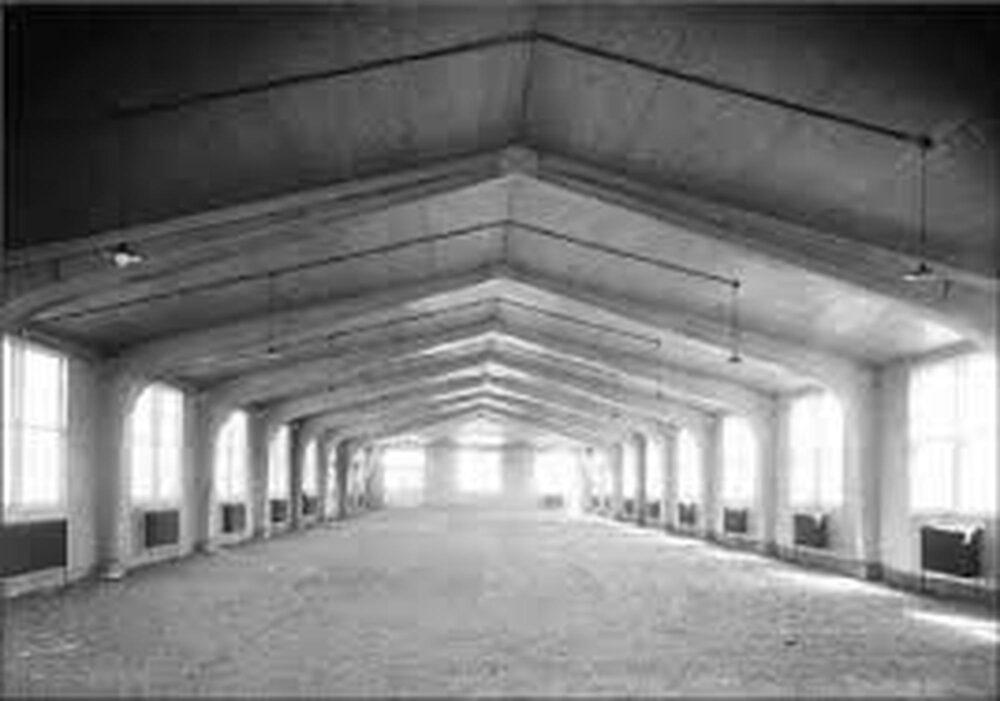
Glue laminating is the process of laminating together a number of small pieces of lumber into a single, large, strong structural member. These members can be used as columns, beams and arches.
The technology largely developed in Europe with elements being seen in two churches in 1840s England and four further churches in the 1950s. The earliest still-standing glulam roof structure is from the King Edward VI College in Southampton, England dating from 1866. From 1872 onwards we see patents being developed in Germany for innovative timber products and in 1906 we see the first patent for something that is recognizable today as a standardized horizontal glulam beam. From 1911 onwards we see glulam portals being used in buildings in Switzerland.
One of the first glulam structures erected in the United States was a research laboratory at the USDA Forest Products Laboratory in Madison, Wisconsin built in 1934 that is still in service today (see Fig. 2). The development of entirely water-resistant adhesives that protect glulam from the elements led to the publication of manufacturing standards by the US Department of Commerce.
- 1 https://www.apawood.org/apas-history
- 2 https://gbdmagazine.com/what-is-clt/
- 3 https://axaxl.com/fast-fast-forward/articles/benefits-and-risks-of-building-with-cross-laminated-timber#:~:text=CLT's%20cost%20for%20materials%20and,so%20requires%20a%20smaller%20foundation.
- 4 https://www.woodworks.org/wp-content/uploads/WoodWorks-Mass-Timber-Projects-Sept-2022.png